
Network at Hainan University Suspected to Manipulate the Peer Review Process
Recently, the 5GH Team uncovered a network at Hainan University and other Chinese universities suspected of manipulating the peer review process.
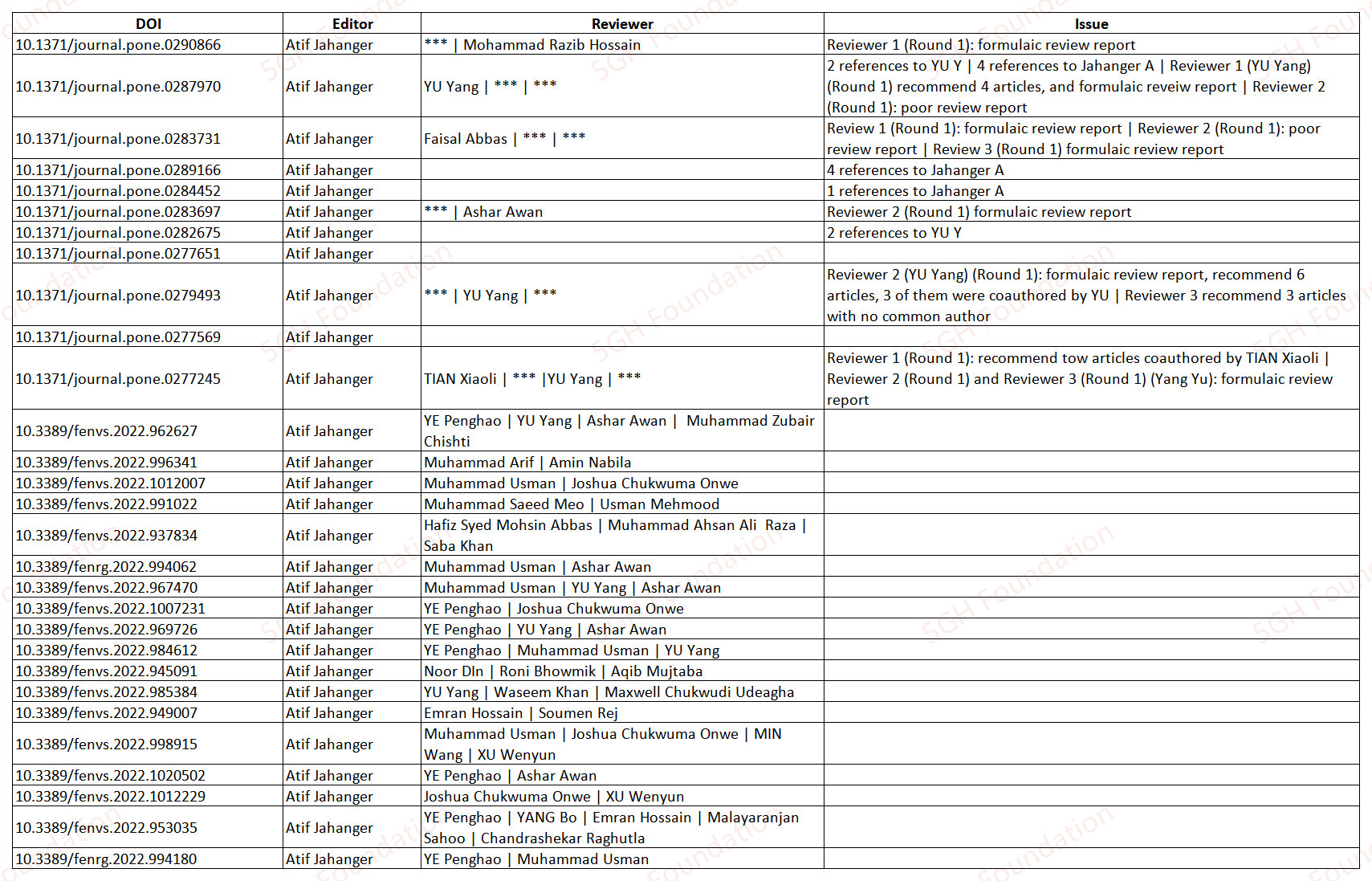
Atif Jahanger from Hainan University was an active editor in 2022. He processed 29 articles across PLoS (11) and Frontiers (18). Of these articles, 24 disclosed the names of the reviewers, although some of the reviewers required to be anonymous (marked with " *** " at the table). A total of 66 reviewer records were successfully compiled, from which 30 distinct reviewers were identified.
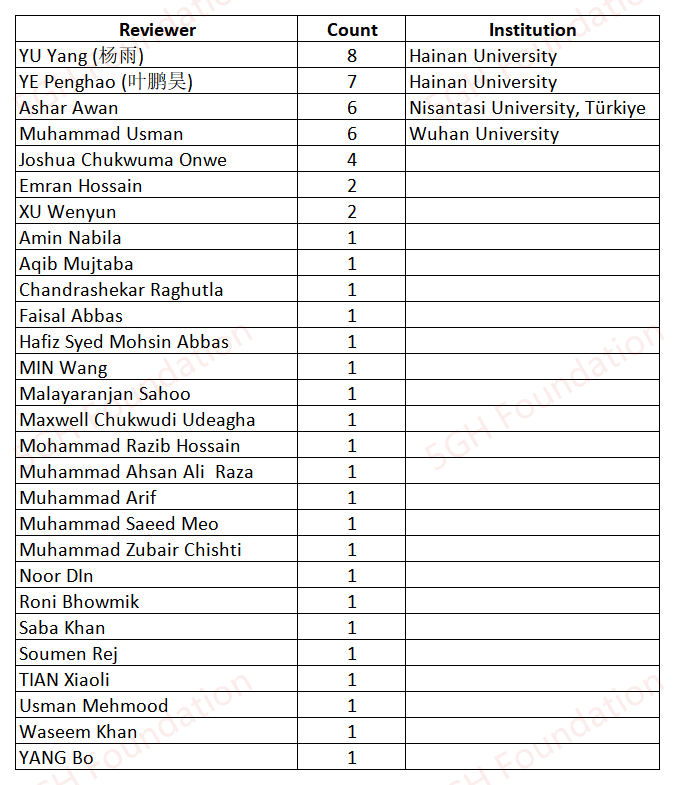
YU Yang (杨雨) and YE Penghao (叶鹏昊) from Hainan University, the same institution with which Atif Jahanger is affiliated to, have 8 and 7 records, respectively, ranking the 1st and 2nd among the identified reviewers, followed by Ashar Awan (6), Muhammad Usman (6), and Joshua Chukwuma Onwe (4). Other reviewers were invited fewer than twice by Atif Jahanger. These patterns suggest that Atif Jahanger relied heavily on a handful reviewers, particularly YU and YE from his own institution.
The 5GH Team notes that the three review reports YU submitted to PLoS ONE are all problematic. They are formulaic and lack any specific details pertaining to the manuscripts under review. In her review report for the article [1], YU recommended 4 references to the authors, all of those recommended references were co-authored by YU. In a separate review report for the article [2], YU recommended 6 references to the authors, 3 of those recommended references were co-authored by YU, too.
While details of the review reports for Frontiers journals remain undisclosed, the patterns observed in the PLoS ONE review reports indicate that improper editorial and peer review practices are widespread within this network.
The Team holds that Atif Jahanger and his network exploited such improper editorial and peer review procedures for personal gain, rather than deliberately permitting low-quality manuscripts to successfully complete peer review. Notwithstanding, these unethical practices have triggered significant concerns over the integrity of the published articles. The Team urges the relevant publishers to conduct a thorough re-evaluation of these works.
Last year, the 5GH Team and another research team independently uncovered a problematic editorial network within the scientific community. Although the affected publishers have committed to strengthening oversight of the peer review process, the identities of individuals in this network have not been disclosed, and none of the editors engaged in questionable editorial practices have been sanctioned. This poses a significant risk to the scientific publishing industry. The Team maintains that exposing this network to the scientific community will assist publishers in implementing effective measures to oversee the peer review process.
Reference