
HUANG Difang's Questionable Editorial and Review Practices at PLoS ONE and Other Journals
A recent investigation by the 5GH Team uncovered the questionable editorial and review practices by HUANG Difang (黄棣芳) on PLoS ONE and other journals.
The Team came across these cases when the team was following the lead by Dr. Oviedo-García. She recently flagged two articles [1, 2] that shared the same handling editor, PENG Jiachao from Wuhan Institute of Technology, China. The Team then reviewed all articles handled by PENG to identify any patterns, and uncovered a problematic article [3].
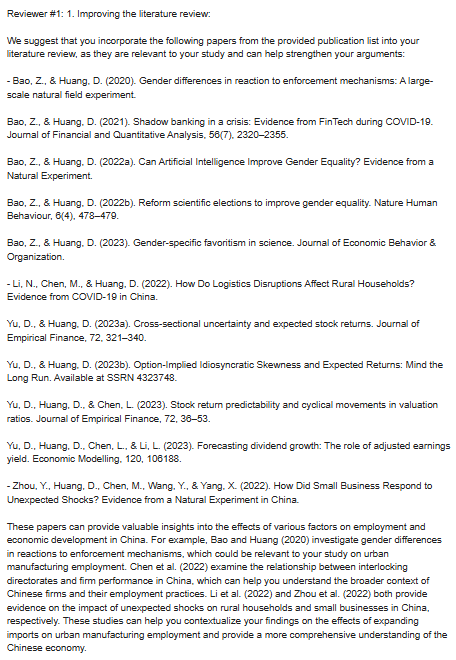
According to the document released alongside the article [3], PENG was the handling editor of the final round of the peer review, while HUANG Difang served as the handling editor for the first and second rounds. In the second around of the peer review, the Review 1 offered 11 references for the authors, and HUANG was a common author across all 11 publications! Although the Reviewer 1 required anonymity, the Team believes that the Reviewer 1 for the article [3] was HUANG himself, suggesting an unethical practice over there.
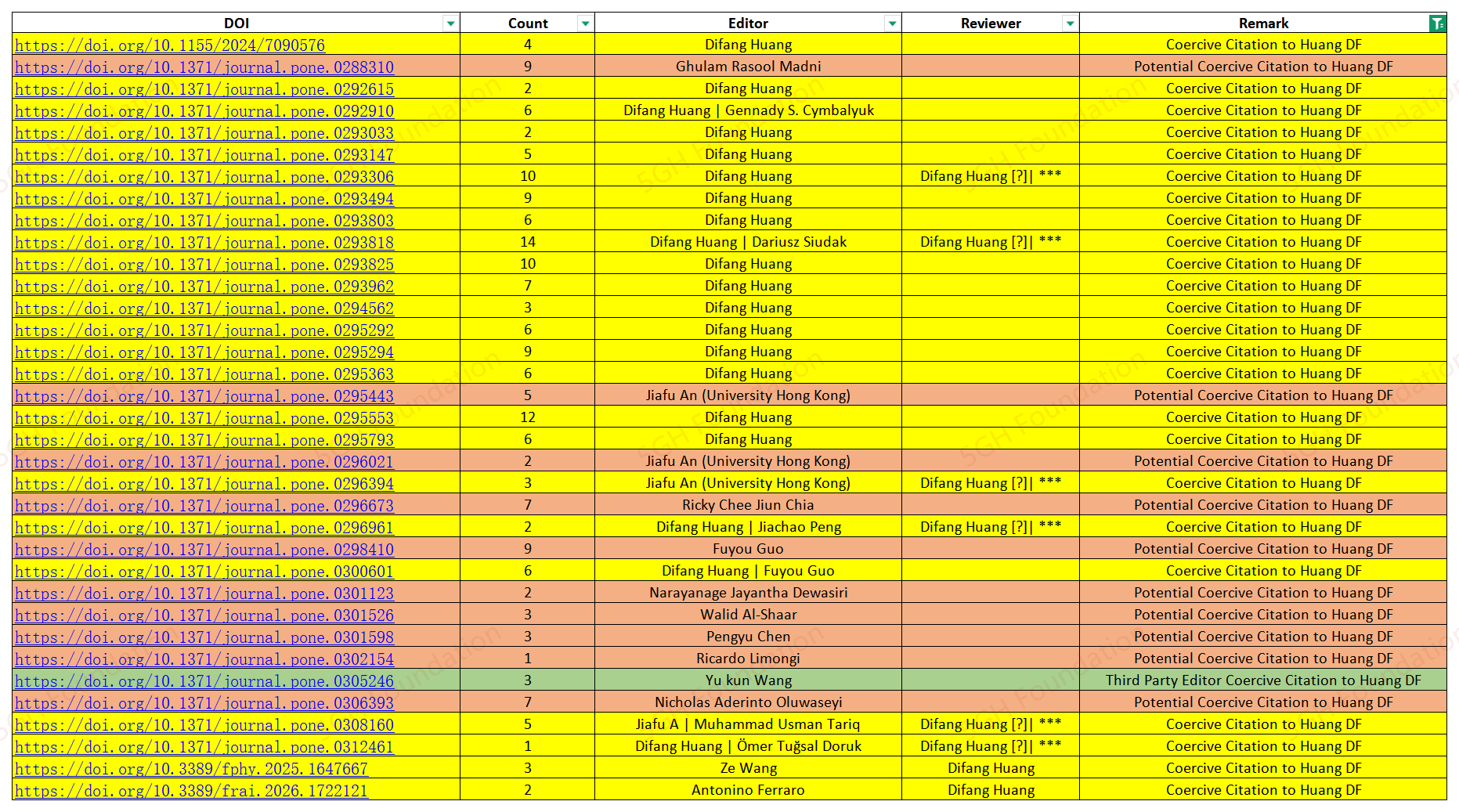
After identifying the unethical practices by HUANG, the Team searched for the articles which cited HUANG's publications. A total of 364 articles were retrieved, and 32 of them were published on PLoS ONE. 20 of those PLoS ONE articles were handled by HUANG. Although most peer-review records for these 32 articles remain unpublished, some were made available alongside the articles. According to those published peer review records, HUANG directed the authors of every article he handled to cite a large number of his own publications, either through Editor Comment or the comment by Reivewer 1, who the Team believes was HUANG himself. On the basis of these consistent patterns, our team concludes that coercive citations were present in every article handled by HUANG, either at PLoS ONE, or at other journals.
Some more unethical practices are identified in the article [4]. This article was handled by HUANG, and during the second round peer review, both the Reviewer 1 and the Reviewer 2 recommended citations to HUANG's publications, implying the existence of a questionable editor–reviewer network, or that those two reviewers were in fact HUANG himself.
The remaining 12 of the 32 PLoS ONE articles were handled by other editors. However, the Team identified several irregular patterns. While peer-review records were published alongside some (but not all) of these 12 articles, in every case where records were available, one reviewer consistently recommended citations to HUANG's publications. For the articles whose review records remained unpublished, our team suspects that a similar reviewer was involved.
In the article [5], the authors stated that "we would like to thank Dr. Huang Difang proposed modification suggestions and Editage (www.editage.cn) for English language editing". It remains unclear whether Editage (意得辑) got involved in such unethical practices.
The Team notes that most of the problematic articles were published on PLoS ONE. This is partly because most of the journals and publishers do not disclose the peer review records, therefore, we can scarcely identify such issues in their review processes. Second, this pattern also indicates inadequate oversight mechanisms implemented by the journal and its publisher during the 2023–2024 period when these articles were published.
Reference
[1] 10.1371/journal.pone.0298312
[2] 10.1371/journal.pone.0301909
[3] 10.1371/journal.pone.0296961