
Comment on 10.1186/s12889-025-25843-x
The article [1] suggests that a structured after-school physical activity program can effectively improve physical fitness, body composition, and sleep of primary school students. This finding is interesting not only to the scientific community, but also to the general public, as physical inactivity and declining physical fitness pose significant risks to the health of Chinese children and adolescents. However, caution is needed when we interpret the results from this study.
The article [1] states that the trial was prospectively registered in the Chinese Clinical Trial Registry (ChiCTR) on December 30, 2022 (Registration No. ChiCTR2200067241). According to the registry document, eligible participants were to be classified as overweight or obese based on age-specific body mass index (BMI) cut-offs. However, the 34 enrolled participants had mean BMIs of approximately 17.03 kg/m2 (control group) and 18.19 kg/m2 (experimental group), both of which fall within the healthy range for children aged 9 to 10 years. These suggest that participant recruitment did not adhere to the registered protocol.
More ever, the 34 participants were recruited and assigned to either the experimental group (regular physical education classes plus a structured after-school physical activity program, five times per week, 40 minutes per session) or the control group (regular physical education classes only). Group allocation was based on participants' preferences. Consequently, students with a greater inclination toward physical activity were more likely to choose the experimental group. Moreover, these individuals may have engaged in additional physical activities beyond both the regular PE classes and the prescribed after-school program. This self-selection process could have introduced bias into the results.
A key methodological ambiguity concerns the primary outcome. Although the Abstract and Results sections report the 50m × 8 shuttle run test as the primary measure, the Methods section describes the 1‑minute sit‑up test as such. This inconsistency undermines the interpretability of the findings, and the authors do not clarify why the primary outcome was changed or how it was actually assessed.
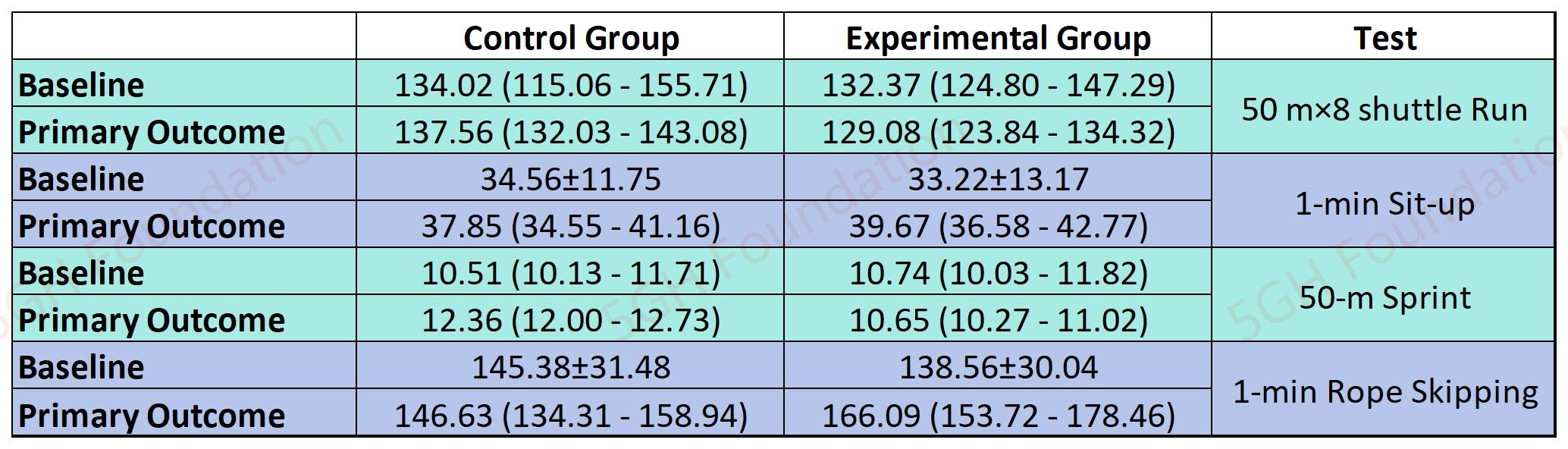
Article [1] claims a significant effect of the intervention on the 50m × 8 shuttle run test. Nevertheless, the validity of this finding is questionable. As shown in the table below, the post-intervention values are considerably more homogeneous than the baseline values, a pattern that is unexpected in repeated measures and may indicate improper data collection or handling. This observation warrants a closer examination of the post-intervention measurement procedures.
Reference