
Higher education graduates in 16 Muslim-majority countries, 2010–2019
Higher education in many Muslim-majority countries has expanded rapidly over the past two decades. But expansion raises a question that enrolment figures cannot answer: who actually completes a degree, and at what level? A harmonised dataset from UNESCO's Institute for Statistics allows a closer look at 16 countries: Indonesia, Iran, Bangladesh, Turkey, Egypt, Saudi Arabia, Malaysia, Kazakhstan, Morocco, Sudan, Afghanistan, Uzbekistan, Jordan, Tunisia, Syria and the United Arab Emirates.
The dataset counts successful completions rather than enrolment. It distinguishes bachelor's (ISCED 6), master's (ISCED 7) and doctoral (ISCED 8) graduates, and records the number of women and men in each category. For cross-country comparison, the analysis uses each country's latest “reference year” in which all three levels and female counts are available—2014 to 2019. Female share is the number of female graduates divided by total graduates at the same level. Because the reference years differ, the totals describe the panel's latest available structure rather than a single calendar year.
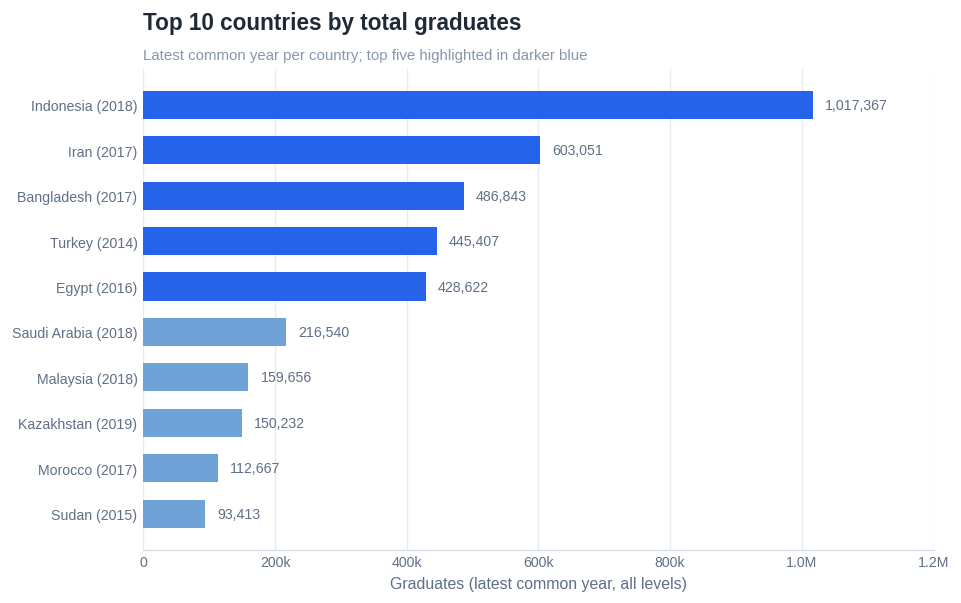
Across those reference years, the 16 countries produced a combined 4.05 million graduates. Bachelor's degrees dominate: 3.48 million, or 86% of the total. Master's degrees account for 528,000 and PhDs for 39,000. The panel is also concentrated. Indonesia alone produced 1.02 million graduates, about a quarter of the total; Iran, Bangladesh, Turkey and Egypt follow. Together, the top five account for nearly three-quarters of all graduates in the panel (Figure 1).
At first glance, the gender picture is close to parity: women make up 49.6% of all graduates. But the aggregate conceals a clear gradient. Women earned 50.6% of bachelor's degrees—slightly more than half—but 43.7% of master's and 42.9% of PhDs. The gap widens by about seven to eight percentage points between the first degree and advanced research degrees. That is not a trivial difference: it is at the transition to postgraduate study, and then to doctoral research, that women's representation begins to fall (Figure 2).
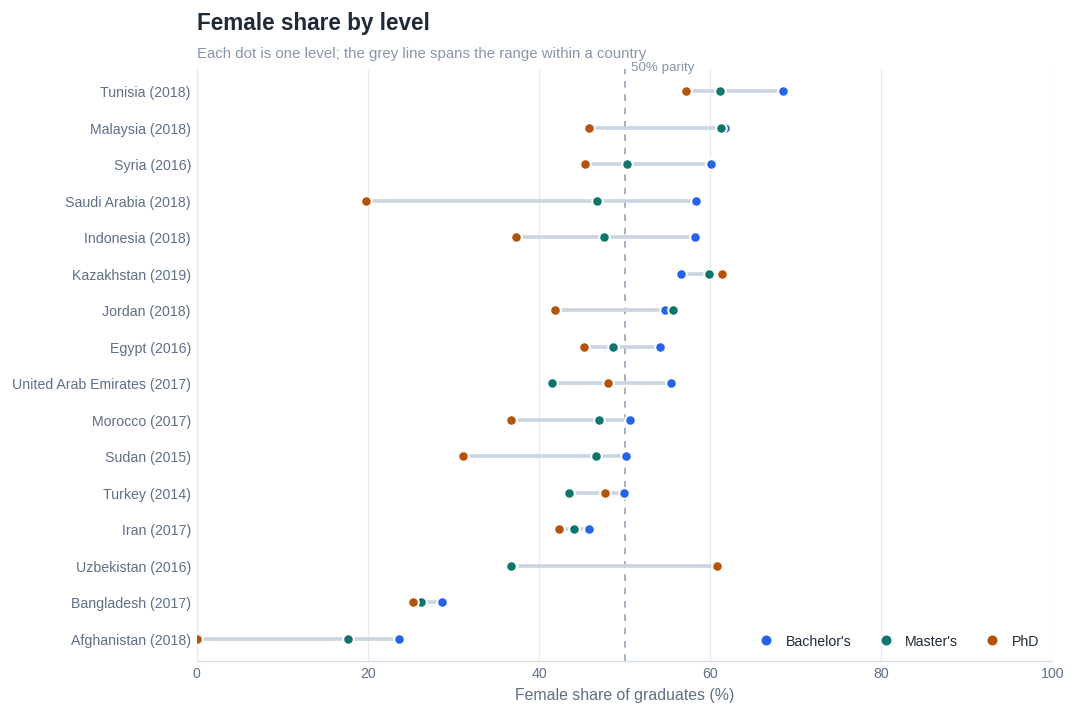
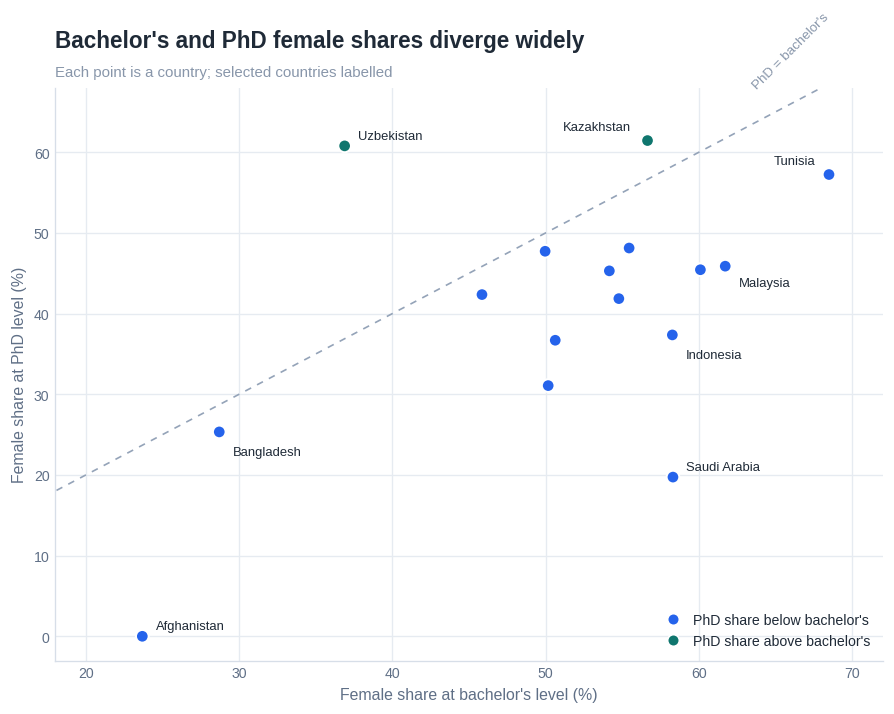
The gradient is common but not universal. Indonesia, the largest system, illustrates it sharply: women are 58.3% of bachelor's graduates, 47.6% of master's and 37.4% of PhDs. Saudi Arabia shows an even wider span: 58.3% at bachelor's level but 19.7% at PhD level, based on 451 doctoral graduates. Morocco (50.6% to 36.7%) and Sudan (50.2% to 31.1%) display similar patterns. In Turkey, by contrast, the PhD share (47.7%) is higher than the master's share (43.5%), and Kazakhstan and Uzbekistan report higher female shares at PhD than at bachelor's level—although their doctoral cohorts are small (721 and 51 graduates respectively). The lesson is that “the gender gap” is not one uniform phenomenon (Figure 3).
Country differences are equally striking. Tunisia has the highest overall female share in the panel (65.7%), followed by Malaysia (61.2%), Syria (59.6%), Saudi Arabia (57.7%), Indonesia (57.2%) and Kazakhstan (57.1%). At the other end, Bangladesh (28.2%) and Afghanistan (23.6%) are far below the rest. Afghanistan's case is extreme at every level: 23.7% at bachelor's, 17.7% at master's, and no women among 10 PhD graduates. The last figure is too small to support strong conclusions, but it is consistent with the broader pattern of constrained female access to advanced study.
“The gender gap” is not one uniform phenomenon. It changes with degree level, and it changes across countries.
These numbers matter because graduate degrees are not just additional years of schooling. Master's and doctoral programmes are the gateway to research careers, academic posts and many senior professional roles. A 50/50 balance at bachelor's level can coexist with a much thinner female presence in the pipeline that produces university teachers, scientists and senior analysts. At the same time, counts alone cannot explain why the gradient exists. They do not tell us whether the gap reflects lower application rates, higher dropout, field sorting, financial constraints, family responsibilities or labour-market expectations. Answering those questions requires cohort and field-level data, which most countries in the panel do not publish in comparable form.
The dataset also has important limits. The version used here is UNESCO's February 2020 non-core archive, and its level-specific counts end in 2019; the current SDG 4 and OPRI releases reviewed for this brief do not contain these series. Four large Muslim-majority countries—Pakistan, Nigeria, Iraq and Yemen—have no usable level-specific counts for 2010–2019, and Algeria and Senegal have only partial coverage. The 16-country panel is therefore not a representative sample of the Muslim-majority world. Reporting gaps and discontinuities in countries such as Egypt, Uzbekistan and Bangladesh also caution against reading year-to-year changes as pure trends, and no estimates or imputations have been made.
What the data do offer is a baseline. They show that mass higher education in these 16 countries is already a reality, that women are close to half of all graduates, and that their representation narrows at the point where academic and research careers begin. They also show that national stories diverge widely: Tunisia and Malaysia are near or above parity across much of the pipeline, while Bangladesh and Afghanistan remain far behind. For policymakers, the relevant question is no longer only how many graduates a system produces, but who progresses beyond the bachelor's degree. For researchers, the gaps in coverage are themselves a finding: reliable, sex-disaggregated graduate data remain scarce in some of the countries where the stakes are highest.
Reference
[1] Data