
Less than 60% Articles from Chinese Universities Are Open Access to Public
A recent investigation shows that the proportion of papers published by Chinese universities that are openly accessible to the public is relatively low. The 5GH Team collected the publication records from 22 Chinese universities, and reached the above conclusion.
Those 22 universities are: Sun Yat-Sen University, South China University of Technology, Fudan University, Shanghai Jiaotong University, Wuhan University, Nanjing University, Peking University, Tsinghua University, Zhejiang University, University of Science and Technology of China, Southern University of Science and Technology, Huazhong University of Science and Technology, Xi'an Jiaotong University, Westlake University, Tongji University, Harbin Institute of Technology, Beijing University of Aeronautics and Astronautics, Beijing Institute of Technology, Hong Kong University, Chinese University of Hong Kong, Hong Kong University of Science and Technology, and Hong Kong Polytechnic University.
For comparison, MIT was included in this investigation.
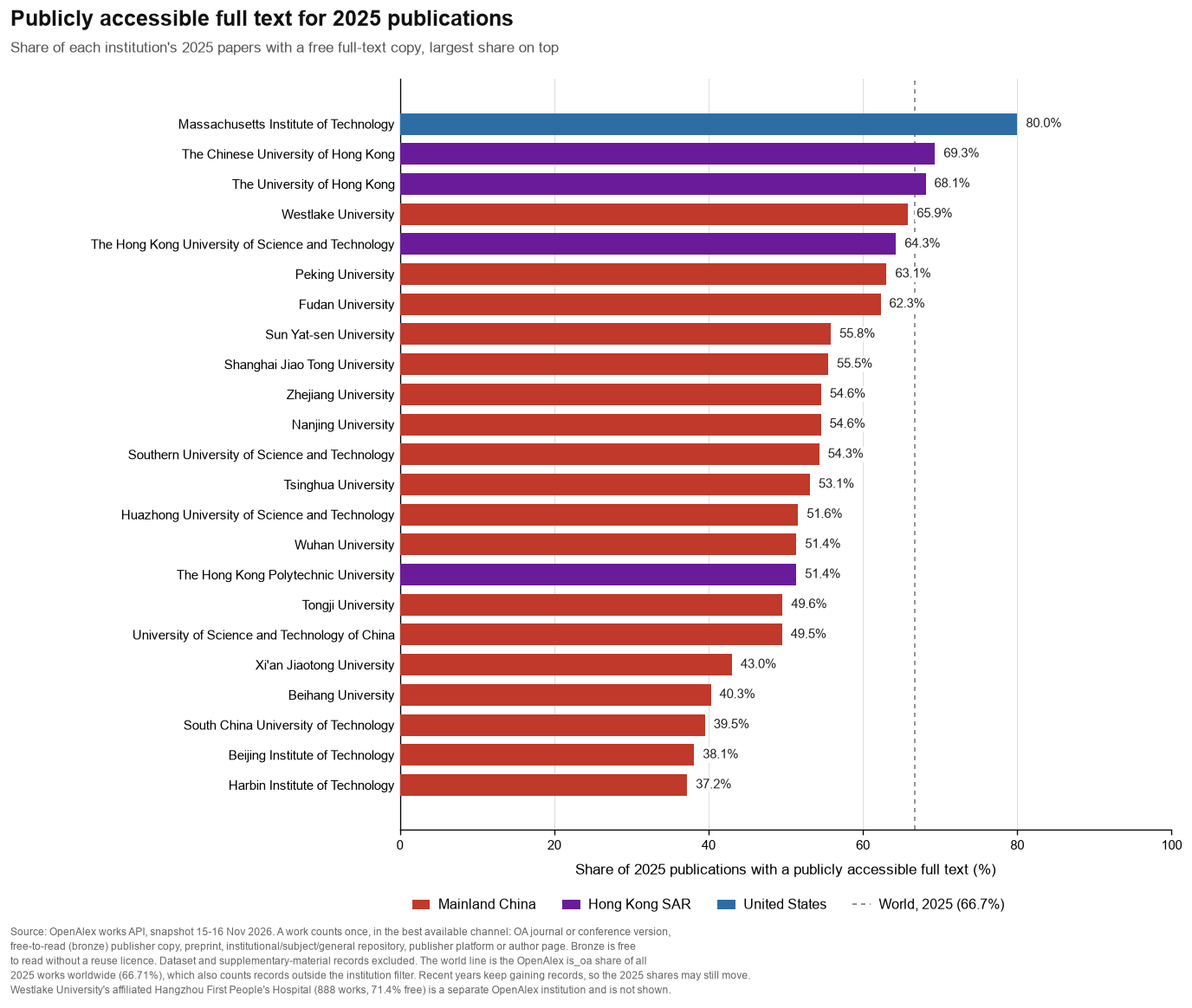
Results show that the proportions for the universities in mainland China ranges from 37.2% (Harbin Institute of Technology) to 65.8% (Westlake University), which is lower than those for the universities in Hong Kong and United Stated. The numbers for the universities in Hong Kong are slightly higher, range from 51.4% (Hong Kong Polytechnic University) to 69.3% (Chinese University of Hong Kong), while it is 80.0% for MIT.
Publishing in open-access journals, or publishing under an open-access model in hybrid journals, is the primary means by which papers published by Chinese universities become openly accessible to the public. In recent years, posting preprints has become another major route to public open access for these papers. By contrast, institutional repositories have made little progress, even though many countries have adopted policies requiring researchers to deposit author accepted manuscripts in national repositories.
The development of open science in China faces several challenges, one of which is that Chinese researchers tend to prioritize their KPIs over open science. This is largely because research evaluation in China still relies heavily on publication counts, journal impact factors, and project metrics, which discourages researchers from investing time in open science practices. As a result, open science practices are often seen as costly, risky, or unrewarded, even when they improve transparency and public access.